skip to main |
skip to sidebar
 SONIC YOUTHExperimental Jet Set, Trash And No Star - (1994)Whereas Dirty and its predecessors were loud, distorted, and bordering on the fine line between pop and noise, Experimental Jet Set, Trash & No Star did away with the ear-bleeding guitar feedback so often attributed to the group. The group retained its quirky twist on pop/rock song structures, moving even closer to a consistent use of the verse-chorus-verse template. Of course, the disregard for mosh-friendly guitar riffs, lack of crowd-surfing intensity, and increasing traces of normalcy killed a large part of the group's momentous surge in popular acceptance, damning them once again to the status of often misunderstood artists. Popular opinion may have wanted more rock than what Sonic Youth wanted to deliver on this album, yet upon careful inspection, Experimental Jet Set, Trash & No Star still out-noises the majority of its peers. Butch Vig's clean production makes the album seem clean, when in actuality it is nearly as dirty as the group's preceding effort. Songs such as "Starfield Road" and the acoustic song "Winner's Blues" emanate plenty of raw spontaneity, even with Vig's crystal clear production. Relative to Sonic Youth's greater body of work, the album does seem rather sedate, though. The noises resonate subtly rather than mangle one's eardrum. In sum, this record must be considered the closest the group has ever gone to straight-ahead pop/rock. With all of the feedback, murky production, incoherent song structuring, and rambunctious charisma stripped away, what remains are odd lyrics and unique guitar nuance. In other words, Experimental Jet Set, Trash & No Star features the underlying foundation of the group's music standing naked, without any of their traditionally excessive static to heighten it. (allmusic.com)http://www.mediafire.com/?4awss1lw8lz04ypExperimental Jet Set, Trash And No Star - Early Rough Mixeshttp://www.mediafire.com/?38yvcnod2x891ov
 SONIC YOUTHSyr 1 - (1997)Sonic Youth invested the money they earned as Lollapalooza headliners in 1995 in a new studio. Owning their own studio gave them the freedom to experiment as they were recording, since they no longer had to pay rental fees. To inaugurate their new studio, they set out to record a series of experimental instrumental EPs with engineer Wharton Tiers, all of which would be released on the quartet's own label. With its winding, elliptical improvised instrumentals, SYR 1 set the tone for the entire series. Musically, the EP isn't far removed from the instrumental sections on Sister or Daydream Nation, but this music isn't merely waves of feedback -- it's considered, detailed, and bizarrely accessible. Like the epic "The Diamond Sea," the four songs have shifting sonic colors, as simple riffs build and intertwine, crossing over each other before finding a new path. It's closer to avant-garde than rock, but the music isn't purely cerebral, either. Recognizable statements float in and out of the mix, providing something of a touchstone for the free-form explorations. SYR 1 also has brevity on its side. The EP lasts 25 minutes -- which is just enough time to provide an exciting blueprint for a new era of Sonic Youth. (allmusic.com)http://www.mediafire.com/?gnoq08bggxagezr
 SONIC YOUTHEvol - (1986)Sonic Youth made their first moves toward rock with EVOL, a stunningly fluent mixture of avant-garde instrumentation and subversions of rock & roll. The band benefits greatly from the addition of structure, which gives its aural experiments a firm grounding, but the addition of drummer Steve Shelley is essential to the group's new, dangerous edge. With the added propulsion, the fearless rush of "Expressway to Yr Skull" (aka "Madonna, Sean and Me") and the near-pop of "Green Light" are undeniably powerful as are the eerie textures of "Shadow of a Doubt."http://www.mediafire.com/?5cqnkjqv6j4yvxd
 SONIC YOUTHSilver Session For Jason Knuth - (1998)Of the many strange recordings released by Sonic Youth over the course of their long career, few measure up to Silver Session for Jason Knuth. On the inside of the CD sleeve, guitarist Thurston Moore explains the unique situation involving this record and what sort of music to expect. Sonic Youth have been known to drift away from the pop/rock precedent with their tendency to incorporate untraditionally tuned guitars, feedback-driven noise, incoherent lyrics, and odd song structures into their music. On this record, though, they completely abandon any sort of rock-related clichés, instead delivering eight songs of lively guitar feedback. According to Moore, while the band tried to record the vocals for their A Thousand Leaves album one evening, a band in the neighboring studio proceeded to play "some funky metal overdrive." Frustrated over the incident, Sonic Youth turned every amplifier in their studio to ten-plus and leaned as many guitars as they could against them, creating a cacophony of ear-piercing feedback. The group recorded the session and mixed it into digestible sections. Surprisingly, the resulting record has quite a serene feel, with the feedback taking on a beautiful ambient aura. The record also functions as an ode to Jason Knuth, a Sonic Youth fan who committed suicide. Proceeds from the CD went to San Francisco Suicide Prevention Hotline. Don't consider this one of the influential group's most important albums by any means, but do consider it an interesting addition to their catalog, intended mainly for loyal fans. (allmusic.com)http://www.mediafire.com/?jnfno2mqyom
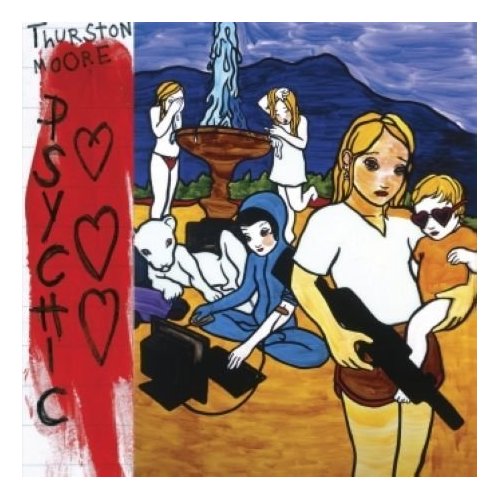
 THURSTON MOOREPsychic Hearts - (1995)It was inevitable that Thurston Moore's first solo offering would sound a bit like Sonic Youth, considering how integral his guitar playing and singing are to the band's sound. What is surprising about Psychic Hearts is how Moore twists his standard lexicon of detatched vocals, dissonant guitar lines, and deliberately obscure musical/lyrical references into something resembling pop music, which is something Sonic Youth has rarely been able to achieve. Fourteen of the album's 15 tracks are built around concise, angular guitar hooks complemented by Moore's unashamed, nearly melodic vocals. "Elegy for All the Dead Rock Stars" is a 20-minute instrumental, which is measured and evenly paced, surging toward a gentle conclusion. Psychic Hearts displays a softer, more reflective side of a musician known for his passion for disguising his emotions and ideas in noise. http://www.mediafire.com/?miyyntymhnu
 SONIC YOUTHWashing Machine - (1995)This album finds Sonic Youth returning to the fearless exploration of their SST records, but the group has found a way to work that into tighter song structures. Not only are the songs more immediate than most of the material on their earlier records, the sound here is warm and open, making Washing Machine their most mature and welcoming record to date. It's not a commercial record, nor is it a pop record, but Washing Machine encompasses everything that made Sonic Youth innovators, and shows that they can continue to grow, finding new paths inside their signature sound. http://www.mediafire.com/?nythdmzmdmu
 CONDO PAINTINGOriginal Motion Picture Soundtrack - (1998)In this documentary, director John McNaughton, famous (or infamous) for Henry: Portrait of a Serial Killer (1990), draws an intimate portrait of the painter George Condo, a friend of William Burroughs and Allen Ginsberg. Born in 1957, Condo has been called the high priest of "artificial realism," which he defines as a "realistic representation of something that's artificial." The film also shows Condo at work in his Manhattan studio; it was shot with a High-8 (non-digital) home video camera which gave McNaughton the freedom of movement to capture close-ups of brush movements and other minute details. It was later transferred to 35mm. There is also footage of Burroughs and Ginsberg in Condo's studio shortly before they both died. Condo Painting was screened as part of the Filmmakers of the Present section in the 1999 Locarno International Film Festival. Although I have never seen this movie, I do enjoy the soundtrack. It features tunes from The Residents, Tom Waits, Sonic Youth, Morphine, King Crimson and Sebadoh. Check it out!http://www.mediafire.com/?nnwmtnzzndk
 SONIC YOUTHThe Walls Have Ears - (1986)The Walls Have Ears is a Sonic Youth live recording from 1985. It was released on 2x12" vinyl in 1986. Tracks 1-8 were recorded live October 30, 1985 in London. Track 9 was recorded live November 8, 1985 in Brighton Beach. Tracks 10-17 were recorded live April 28, 1985 in London. The official pressing was a numbered edition of 2,000, though there are more unnumbered copies indicating a second pressing. This is considered to be one of SY's better non studio, official bootleg recordings.http://www.mediafire.com/?sharekey=300c8e89fa751bc3ab1eab3e9fa335ca3a3f62a78290788e
 SONIC YOUTHDaydream Nation - (1988)By refining the song-oriented breakthroughs of Sister and developing their fascination with noise and alternate tunings, Sonic Youth created a masterpiece of post-punk art rock with the double-album Daydream Nation. Though the self-conscious sprawl of the album might appear self-indulgent on the surface, Daydream Nation is powered by a sustained vision, one that encapsulates all of the group's quirks and strengths. Alternating between tense, hypnotic instrumental passages and furious noise explosions, the music demonstrates a range of emotions and textures, and in many ways, it's hard not to listen to the record as one long piece of shifting dynamics. But the songs themselves are remarkable, from the anti-anthem of "Teen Age Riot" and the punky "Silver Rocket" to the hazy drug dreams of "Providence" and the rolling waves of "Eric's Trip." Daydream Nation demonstrates the extent to which noise and self-conscious avant art can be incorporated into rock, and the results are nothing short of stunning. (allmusic.com)http://www.megaupload.com/?d=9CFN92VK
 SONIC YOUTH The Eternal - (2009)If anyone thought Sonic Youth were getting a little too comfortable, The Eternal proved they weren't afraid of change, even as they closed in on 30 years of making music together. The Eternal is Sonic Youth's first album for legendary indie label Matador Records after a nearly 20-year stint with Geffen Records, which dovetails nicely with the fact that this is also the band's first album with former Pavement bassist (and Matador alum) Mark Ibold. Sonic Youth even changed their usual songwriting approach, writing and recording tracks in quick batches instead of planning an entire song cycle at once. Dust wasn't allowed to settle on these songs, nor could it — the most striking thing about The Eternal is how hard it rocks. The contemplative haze that drifted over Murray Street, Sonic Nurse, and to a lesser extent Rather Ripped is blasted away by opening track "Sacred Trickster"'s lunging, massive guitars and Kim Gordon's demand to be pressed up against an amp. The rest of the band sounds revitalized, too: Lee Ranaldo's excellent "What We Know" is a furious yet complex rocker, and Thurston Moore sounds like the leader of the gang on "Thunderclap for Bobby Pyn," which name-drops the Heaven's Gate cult and the alias of Germs singer Darby Crash between its "whoa-oh" and "yeah yeah"-fueled choruses. This is the heaviest Sonic Youth have been since Sister, and it's fitting that their return to the indie world touches on their SST days. That's not the only era they revisit, however. "Poison Arrow"'s skronky grind evokes Dirty's sexier moments; "Antenna"'s radio love turns Murray Street's sun-streaked drones into epic pop; and "Calming the Snake"'s tumbling, atonal riffing suggests summery menace as much as it does Sonic Youth's no wave roots. While there's a little bit of almost everything that has made Sonic Youth great over the years, the band hasn't put these elements together in precisely this way before. Considering how expansive their last few albums for Geffen were, The Eternal's relatively concise songs also set it apart, but when Sonic Youth do stretch out, it's with purpose. "Anti-Orgasm" begins as a duet/duel between Gordon and Moore, who trade challenges and come-ons over free-falling guitars that become a rolling, slow-motion excursion; the track's instrumental interplay is more violent, and more sensual, than its words. "Massage the History" is even more vast, encompassing fragile acoustic strumming, distortion storms, and dead calm over its nearly ten-minute expanse. While The Eternal doesn't flow quite as effortlessly as some Sonic Youth albums, it's perfectly balanced, its raw moments tempered by the subtle "Walkin Blue" and "Malibu Gas Station," which creeps so imperceptibly toward its raging guitars that they're almost unnoticed until you're caught in their undercurrent. Sonic Youth's freedom to follow their bliss is what holds The Eternal together; just as paradoxically, the changes they make on this album not only bring excitement to their music, they reaffirm just how consistently good the band has been — and continues to be — over the years. (allmusic.com)http://www.mediafire.com/?sharekey=300c8e89fa751bc395af63b7d44918aaedcca1a580ca972d
 SONIC YOUTH